






Blog
Various versions of solitaire have been popular since the 1700s, but it’s not the only card game in town. There are dozens of ways to play cards alone. Some card games are closer in terms of rules and tactics than others, but there’s almost always a common thread between them.
I enjoy solitaire, but I also like other card games. After being dealt thousands of hands across a variety of games, I’ve noticed some similarities and differences between them. So, what I want to do in this guide is compare solitaire to other card games and tease out some nuggets of information you can use next time you play.
If you’re new to the game, our guide to how to play Solitaire Grand Harvest is a great place to start.
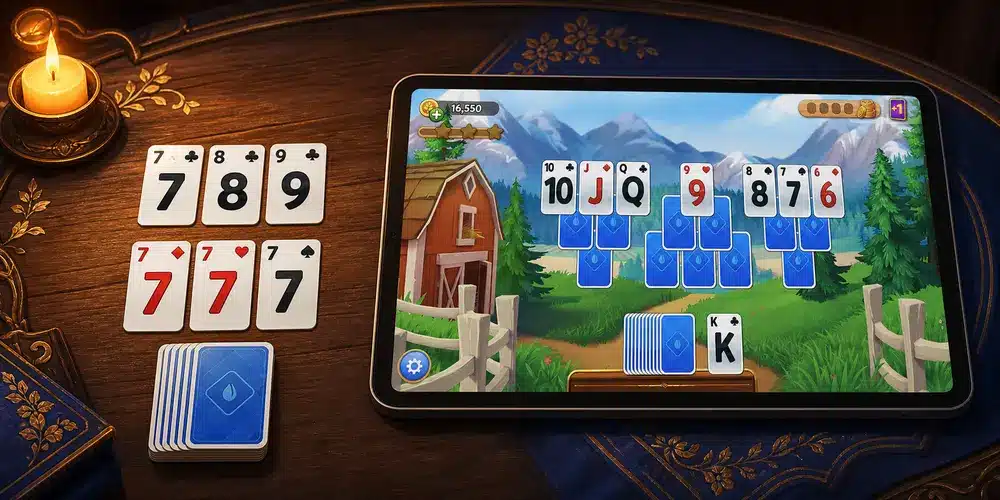
For a full breakdown of how a round works, check out our Solitaire Grand Harvest rules page.
Similarities
- Both are played with 52 cards
- Suits matter
- Different moves can be right in the same scenario
Differences
- You’re competing against people in rummy
- You can discard cards in rummy
- You don’t need to worry about other players in solitaire
Rummy is a strategic card game that contains almost as much psychology as mathematics. The aim is to get rid of your cards by arranging them into melds. Like poker, melds are hands with similar values.
For example, A♦ 2♦ 3♦ is an acceptable meld because the cards are in numerical order and have the same suits. In contrast, A♦ 2♣ 3♥ isn’t a meld because, despite being in numerical order, the cards have different suits.
After receiving an initial selection of cards based on the number of players in the game. For example, if there are two players or three players, everyone gets 10 cards. Play proceeds clockwise from the left of the dealer. You pick up a card from the deck or the discard pile. If you can make a meld, lay it. If not, one card must be discarded.
This dynamic continues until one player has put all their cards into melds. The other interesting rule in rummy is that you can lay off cards. This rule allows players to add a card to an already-made meld. This is a powerful move because it allows you to make melds with a single card.
Expert Insight
One player’s actions can influence another’s in rummy, which means the game’s dynamics are always changing. Even if the cards are dealt in the same way, the dynamics between two games will be different.
That’s because two players can make different moves in the same situation. What’s more, the right moves can yield the wrong results in rummy due to a variety of factors, such as people not acting in ways you expect.
In solitaire, other people don’t affect your moves. You have a level of control that isn’t present in rummy. The lesson here is that you should always make the best logical move in solitaire because outside factors don’t matter. You don’t have this luxury in other card games, so take advantage of it in solitaire.
Solitaire vs. War
For a full breakdown of how a round works, check out our Solitaire Grand Harvest rules page.
Similarities
- Card rankings are identical
- Both games are easy to learn
- Time pressure isn’t a thing in either game
Differences
- You’re competing against the dealer in war
- The dealer’s actions matter in war
- War is a fast-paced card game
War is a one vs. one battle for high-card supremacy. Put simply, you need to get a higher value card than the dealer. The dealer, in this case, is your opponent. What’s great about war is that the rules are incredibly easy to learn.
Two cards are dealt at the start of a game: one to you, one to the dealer. The person with the highest value card wins. Depending on where you’re playing, winning the hand means you get a point. Losing means the dealer gets a point.
The only time things change is if you both draw a card of the same value. In this situation, the player (i.e., you) can either surrender or go to war. Surrendering means you give up and lose half a point.
Going to war means you risk another point. After that, you receive a new card. The dealer then deals three cards face down and turns over the fourth. If your card is higher in value, you win all the points. If not, you lose.
Expert Insight
Aside from being easy to learn, war is a fast-paced card game, which is what makes it different from solitaire. That said, solitaire players can still take something from war. That something, in my opinion, is an appreciation of cards.
For me, there’s value to watching cards being dealt in rapid succession. It helps you understand the nature of randomness. It helps you get a feel for the rhythm of card games. These are important concepts to understand when you’re playing card games, including solitaire.
Essentially, mastering war gives you a better overall understanding of card games. This, in turn, allows you to think through situations in solitaire more logically. In a game where you’re aiming to clear cards efficiently, this is a value skill to have.
Solitaire vs. Euchre
For a full breakdown of how a round works, check out our Solitaire Grand Harvest rules page.
Similarities
- You’re clearing cards in both games
- Suits have value
- You can make attacking and defensive moves
Differences
- You play in teams
- 24 cards used instead of 52
- Point scoring game
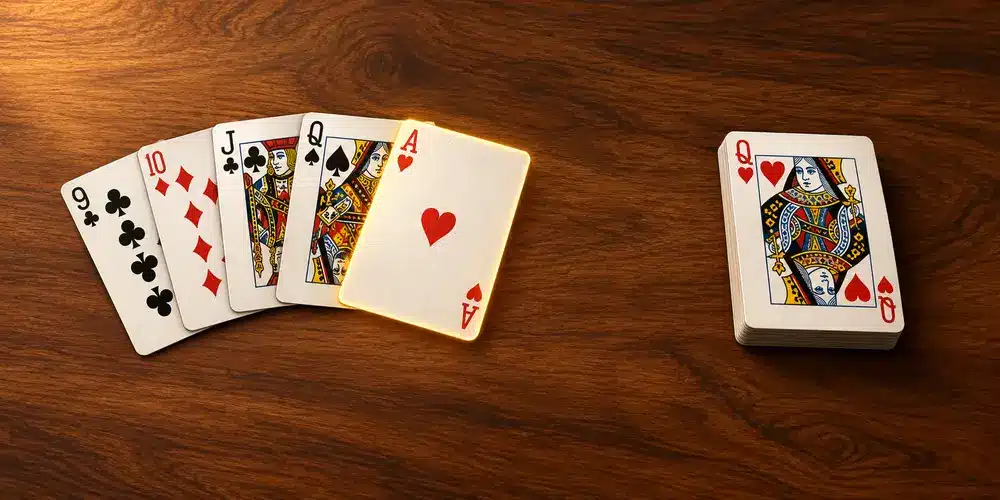
Euchre is a trick-taking card game, which means the aim is to win rounds and score points. The game starts with two teams and a stripped deck of 24 cards. The only cards in play are nines, tens, jacks, queens, kings, and aces.
From there, a trump card (suit) is established, and teams are split into attackers and defenders. Nines are low, aces are high, and the jack of the trump suit is the highest-ranked card. The aim is to clear cards by following suits.
Attackers get one point for winning three or four tricks, two points for winning five tricks, and more if they go alone (aka without anyone else on the team). Defenders get two points for winning three or four tricks, four points for winning five. They also get more for going alone. The winning team is the first to earn 10 points.
Expert Insight
Something I think solitaire players can take from Euchre is its attacking vs. defending dynamic. As per the rules, you get more points for winning tricks as a defender. Reading between the lines, this tells you that it’s harder to win from a defensive position.
In solitaire, a defensive strategy involves preventing dead ends. You do this by focusing more on moving cards around the main board rather than moving them up to the foundation (an attacking move).
This is an effective strategy, but only when used correctly. As evidenced by the point scoring system in Euchre, it’s harder to win from a defensive position. Therefore, in solitaire, you should always be looking to attack (move cards to the foundation) whenever possible.
However, that doesn’t mean you should always attack. Defensive moves are necessary, but they aren’t going to help you clear boards quickly. My point here is that you should find balance in your play.
Different Types of Solitaire
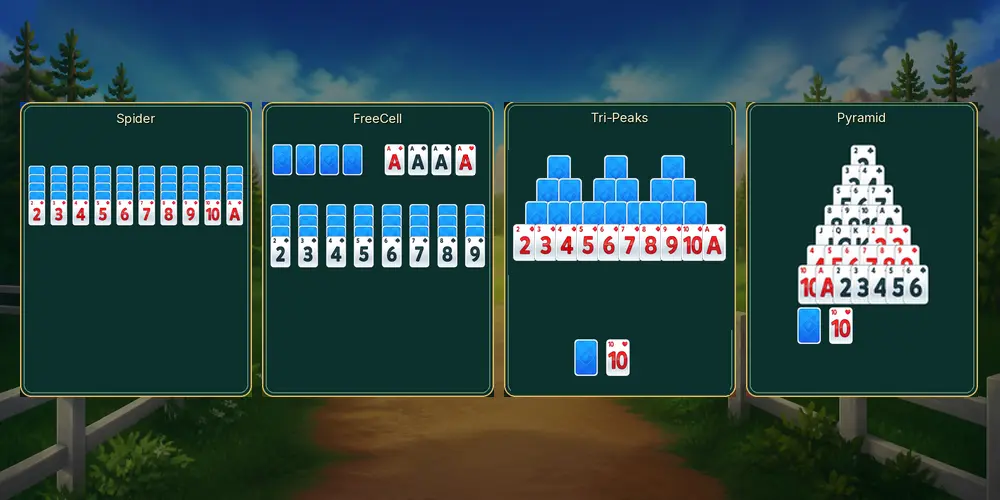
I’ve talked about different card games, how they compare to solitaire, and some crossover skills you can add to your arsenal. Before you rush off, I want to talk about the different types of solitaire you can play.
Classic solitaire, which is the variant you can play here at Solitaire Grand Harvest, is the most popular. However, other variants test your skills in different ways. Here are some of my favorite alternatives to classic solitaire:
Spider Solitaire
This version of solitaire uses 104 cards instead of 52. That’s equivalent to two decks of playing cards. Because more cards are in play, the tableau features 10 columns instead of seven.
The other difference between spider solitaire and classic solitaire is the way cards are moved from the tableau to the foundation. In this game, you can only move cards to one of the eight foundation piles when you’ve completed an entire column (king to ace of the same suit).
Because suits matter much more in spider solitaire than in other versions, it’s possible to have varying degrees of difficulty. For example, a game featuring only one suit is easier than one featuring three.
FreeCell Solitaire
FreeCell is regarded as a slightly easier version of solitaire because all the cards in play are turned face-up. This removes any element of uncertainty because there isn’t a stockpile of hidden cards. Additionally, all cards within a column are visible.
The key to playing FreeCell solitaire is, as the name suggests, using four free cells to move cards. Basically, the free cells act as holding spots in which you can temporarily store cards while you clear others.
Tri Peaks Solitaire
Like other types of solitaire, the clue is in the name when it comes to Tri Peaks. The tableau consists of 28 cards arranged into three peaks built from four rows: 10 cards on the bottom row, nine cards on the second row, six cards on the third row, and three cards on the fourth row.
The aim is to move cards from the tableau to a single foundation. You’re allowed to move any card from the tableau if it’s one rank higher or lower than the face-up card on the foundation. If you can’t move a card from the tableau, turn over the top card from the stockpile and use this as the new foundation card.
Pyramid Solitaire
Pyramid solitaire is regarded as one of the most difficult variants because you can only cycle through the stockpile once. This means that you can’t make any mistakes because you don’t get another chance to revisit cards.
The aim is to clear all cards from the pyramid-shaped tableau. A waste pile accompanies the stockpile and tableau. You can use cards from any of these piles to make a pair. The combined value of the pair must be 13, e.g., 10 + 3 = 13. This clears the two cards.
All cards have their face value, except Aces (one), Jacks (11), Queens (12), and Kings (13). You win the game by making enough pairs to clear the tableau.
Curious what else sets Grand Harvest apart from other card games? See Way More Than Just Solitaire.
Play, Think Logically, and Have Fun

Solitaire is highly entertaining, but, as I’ve explained, there’s also a logical side to the game. Many of the skills required to play solitaire online are used in other pursuits, which is why it’s useful to know the basics of other card games, such as rummy.
I’m not saying you need to become an expert in other card games. In fact, you don’t even need to play them. However, there’s certainly value in learning their rules and some basic strategies. Doing this will give you a better understanding of how games of chance work and, in turn, a better appreciation of cards.
In my opinion, this can only be a good thing. When you’re able to think logically about card games like solitaire, they instantly become more enjoyable. So, with this in mind, make sure you think about everything I’ve discussed in this guide so you can have more fun the next time you play at Solitaire Grand Harvest.
For more stories like this one, check out the latest updates on our Farm News blog.